


Ceramic Inks – create graphic patterns and illustrations on ceramics
Would you like to print patterns, illustrations, or text on ceramics? Ceramic Inks make it possible to work with ceramics in a way that resembles graphic design and printmaking techniques.
What are Ceramic Inks?
Ceramic Inks are highly pigmented ceramic colors used to create graphic motifs and decorations on pottery. They are usually applied in thin layers and are especially suited for printing techniques.
Unlike traditional glazes, Ceramic Inks are developed for techniques such as stenciling, screen printing, and stamping, where clear lines and sharp designs are desired. They can be applied to both leather-hard clay and bisque ware, making them a versatile tool for many decorative methods.
They are often used for:
- stencil printing
- screen printing (silkscreen)
- monoprint
- stamping
- hand-painted illustrations
Because the color is applied in thin layers, it is possible to build up details without the design spreading or blurring.
If you would like to try this technique, you can start with Ceramic Inks in different colors and experiment on test tiles or bisque ware.
Techniques you can use with Ceramic Inks
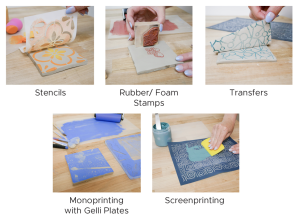
Stencils
Stencils are an easy way to create repeating patterns on ceramics. Place the stencil on the clay surface and dab the ink through the openings with a sponge or stencil brush to create clean, graphic designs.
For best results, use stencils or printing tools designed for ceramic decoration.
Rubber or foam stamps
Rubber or foam stamps allow you to quickly transfer motifs onto clay. Apply a thin layer of Ceramic Ink to the stamp and press it onto the surface to create clear decorative impressions.
Transfers
Ceramic Inks can also be used to create transfer prints. The design is first printed onto a temporary surface such as paper and then transferred onto the clay.
Monoprinting with Gelli Plates
Monoprinting creates unique prints where each result is slightly different. Ink is rolled onto a Gelli plate, textures or patterns are added, and the image is transferred to the clay surface.
Screen printing
Screenprinting (silkscreen) allows you to apply detailed designs with high precision. Ink is pushed through a mesh screen using a squeegee to transfer the design onto the clay.
Clear glasyr – for a durable surface
Once the design is finished, you can cover the decoration with a transparent clear glaze. This protects the decoration and creates a smooth, glossy surface after firing.
A clear glaze:
- protects the design
- makes the surface easier to clean
- enhances the colors
If the ceramic will be used for food or drinks, it is important to use a food-safe clear glaze. See clear glazes for stoneware and clear glazes for earthenware.
Tips when working with Ceramic Inks
- Apply thin layers for sharper designs
- Always test new techniques on a test tile
- Let the ink dry before applying glaze
- Document color mixes and results
What can you make with Ceramic Inks?
Ceramic Inks are often used for:
- illustrated mugs
- patterned plates and dishes
- graphic tiles
- decorative wall tiles
- text and signatures on ceramics
The technique is especially popular among ceramic artists who want to combine ceramics, illustration, and graphic design.
Summary
Ceramic Inks open up new possibilities for decorating ceramics using graphic techniques. By using stencils, screen printing, or stamps, you can create patterns and illustrations with high precision.
When the decoration is covered with a clear glaze, the result becomes both durable and visually striking – perfect for everything from decorative objects to functional ware.
Video